I don’t know how my first composition notebook, ended up in my hands, long before I could really write, someone must have known that this, was all I needed.”
-Jacqueline Woodson, Brown Girl Dreaming
Narrative writing is one of the most common types of writing in the classroom. However, I believe it to be the hardest. Many students don’t know what to write about, what to add details to, or how to get started. As a child, I used to hate when teachers told me to “write whatever you want to write about” or “free write” option. I wish that I had guidelines to follow, but not necessarily told exactly what to write.
Writing is something that I find a lot of comfort in. I like writing with expression and in detail. When I was younger, I was inspired by one of my teachers to keep a writing journal. They had a writing journal of “funny quotes that their students had told them.” This inspired me to keep a journal of funny things that happened to me. Then, this writing journal transitioned to happy things, sad things, proud moments, and middle school crushes.One important lesson (without explicitly teaching it) is modeling of writing. If students see you writing on a constant basis, they will too, start writing on a constant basis. Although it won’t guide them what to write, or how to write, it is a starting place for future writers.
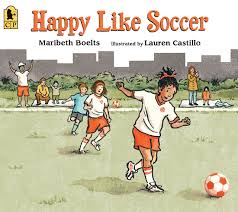
I plan on helping my students find writing topics through shared reading. Through these shared reading experiences, students cane find their voice and discover personal experiences through what the read. For Example, if I used Happy Like Soccer as a shared reading text, I can help students discover topics like sports and feeling of happiness and sadness. In Happy Like Soccer, author Maribeth Boelts uses the strategy of ‘Showing, not telling’ to tell us about the characters, plot, and setting. Maribeth Boelts provides reasons and explains why the character is feeling a specific way.
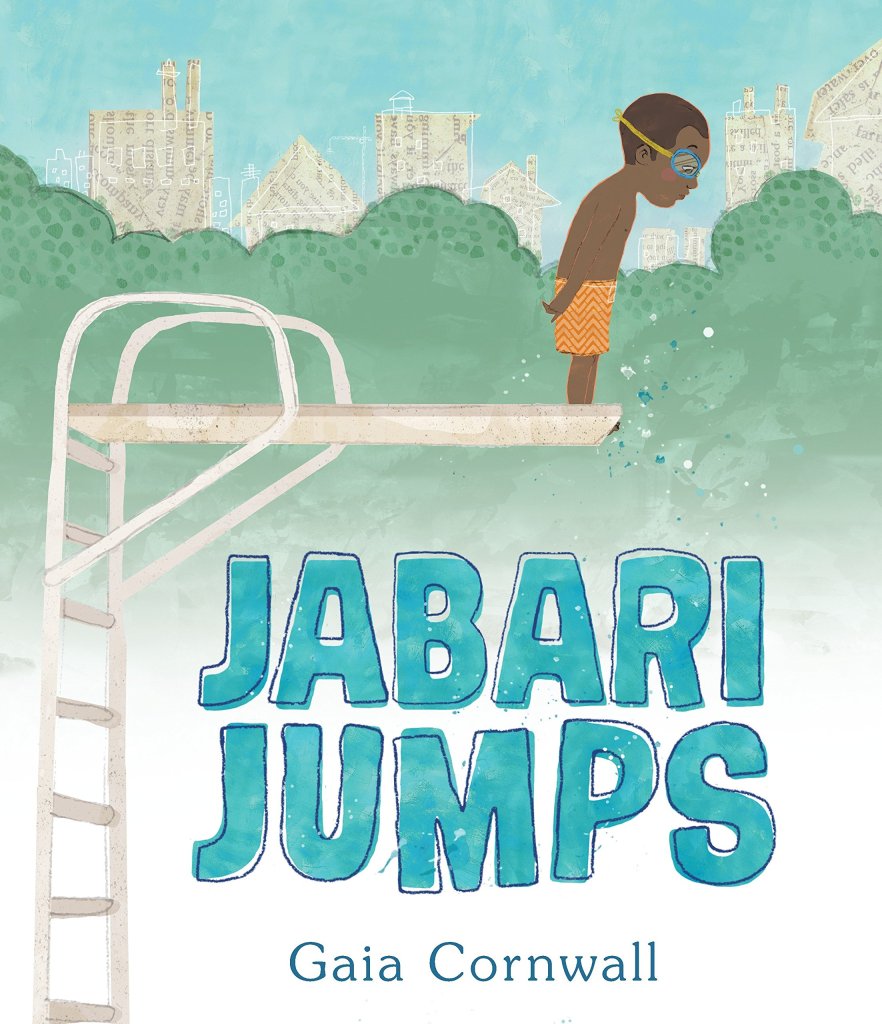
Another way to encourage students to pick topics to write about is read a mentor text, such as Jabari Jumps by Gaia Cornwall. In this book, Jabari faces a roller coaster of emotions while he is trying to face his fear of jumping off the diving board. This book has a profound emotional effect on children of all ages. In this book, students can easily name the emotions that Jabari is feeling through his dialogue and actions.
When students are done reading Jabari Jumps as a whole group, ask students to make a list of emotions that Jabari had felt. Some examples of these emotions would be; fearful, nervous, confident, happiness, and eagerness. Then, the teacher will model the creation of a hand map with the students. On each finger, the students will label an emotion and list stories that they have encountered in that emotion. See the below lesson for more details…
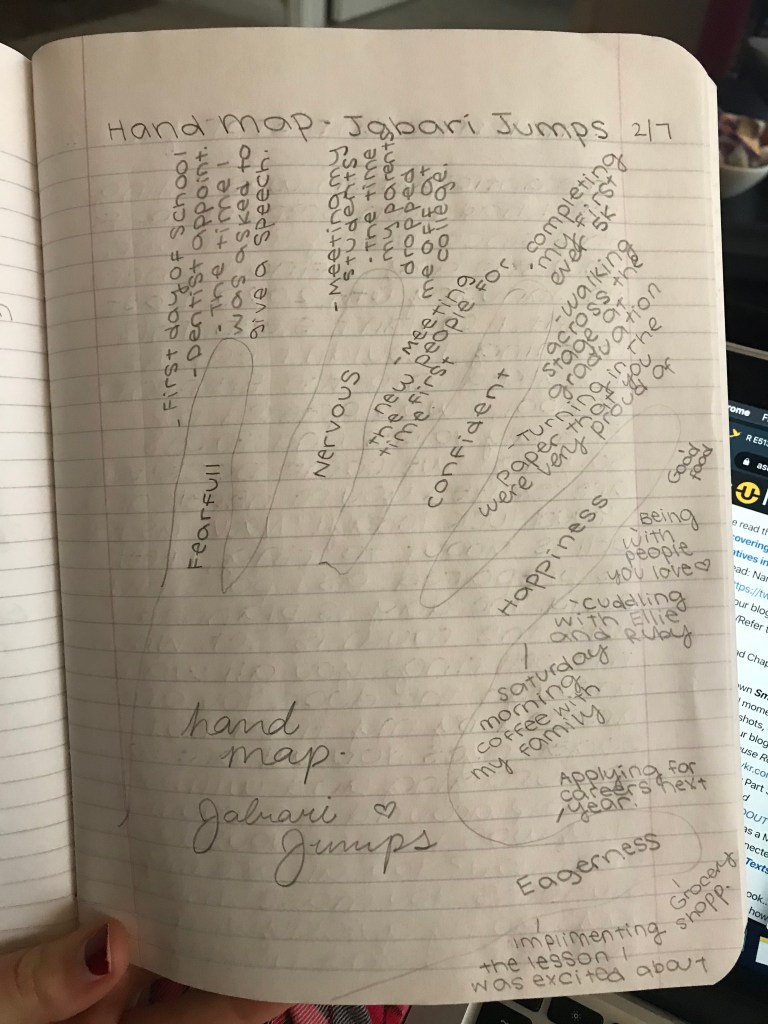
This lesson is an excellent way for students to focus on one specific time in their life. Typically, students have tendency to write like an agenda. From one event, to the next, to the next, etc. However, with this lesson, students can slow down a moment and examine feelings or reveal characters. Tell students to focus on a moment by exploding the moment.
“The anticipation was killing me. I had been preparing for this since early October. Now, the day is finally here. It’s January 6th, 2020. Last night, I couldn’t sleep. This morning, I couldn’t eat. As I walked into the elementary school, I was greeted by friendly voices and faces saying “Welcome back! We are excited you are here!” and “Good luck today!” Now, as the bell is about to ring, I feel as prepared as I possibly could. The day is planned and the room is all set. When the bell rings, you walk through the door. You are greeted by my tired but eager eyes. You all are so encouraging and willing to help around the room. Why was I so nervous to meet you? You all are my students. You make the days go by quickly. With fun stories and happy faces. Maybe you knew that I was nervous. Or maybe you were just as nervous as me?”
One thing that I also really liked about using Jabari Jumps as a mentor text is that the author Gaia Cornwall uses dialogue in her book. When authors dip into dialogue, it creates drama focused around important events. Students can use Gaia Cornwall’s modeling to “sprinkle just enough to bring out the flavor without masking the taste” (Chapter 4. Mentor Texts)
Saturday Morning
By: Abby Smith
Many mornings consist of rushed coffee, breakfast to go, and tired eyes--
but not this one.
The pancake mis that lays idle and dusty throughout the week finally gets a chance to shine.
The sizzling bacon against the greased up black cast iron ignites the house with warmth.
The coffee refills ignite my body with energy
Pajama attire: required. Shoes and socks: optional.
I eat and enjoy the morning without complaining- for it will be Monday soon.
Enjoy the little moments, enjoy the prized Saturday mornings.
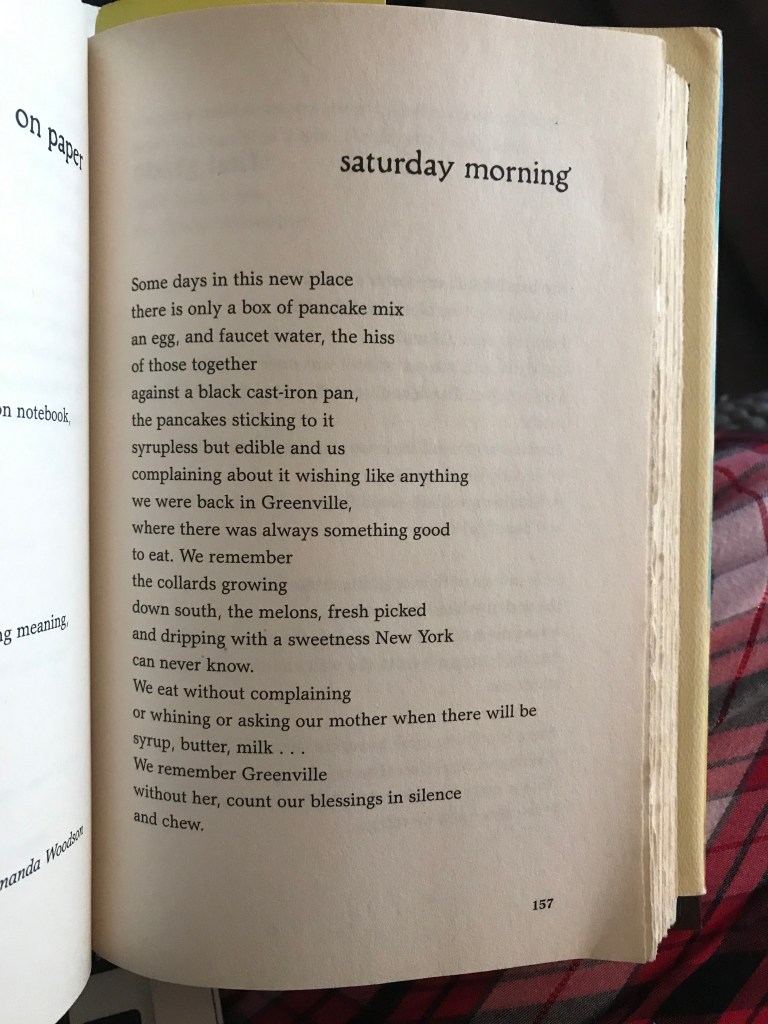
As a writer myself, I use Amy Krouse Rosenthal’s book Textbook and Jacqueline Woodson’s book Brown Girl Dreaming to model and inspire my writing. Out of these two books, I would consider using Brown Girl Dreaming as a mentor text for my students to write from. One way that I could encourage this is to introduce the writing by the title of the page. For example, this past week, I took the page titled ‘Saturday Morning’ to write about my ideal Saturday morning. I can use this page, and many others like this in Brown Girl Dreaming, to have students use descriptive detail to show NOT tell about that topic.
As soon as I read this page in Brown Girl Dreaming, I was inspired to write in my writers notebook about my Saturday mornings. Saturday morning’s are my favorite thing. When I read Jacqueline Woodson’s descriptive words about the pancake mix, black cast-iron pan, syrup, butter and milk, I was reminded of the delicate reasons why I love this time so much. This is why I think it is important to have a variety of mentor texts used in the classroom. Some students, like me, will be instantly inspired about the descriptive use of Jacqueline Woodson’s words. However, not all of my students will. Each mentor text that I bring into the classroom will have different effects on each of my different students.


