
‘My Two Blankets’
My new blanket grew just as warm and soft and comfortable as my old blanket. And now, no matter which blanket I use, I will always be me.”
-My Two Blankets, Kobald & Blackwood
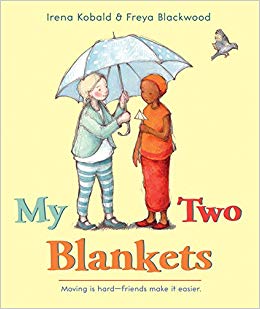
‘My Two Blankets’ by Irena Kobald and Freya Blackwood is an inspiring picture book about friendship. Cartwheel, a young girl, moves to a new country with her aunt. Cartwheel and her aunt had to flee their home country because of war. When they arrive in their new home, everything is strange: the animals, the plants, the people, and even the wind. Irena Kobald and Freya Blackwood do an excellent job in expanding upon immigration to a new country. This theme is dominant throughout the text.
When Cartwheel feels discomfort in this new place, she finds comfort in an old blanket. “My old blanket was warm. It was soft. It covered me all over. It made me feel safe” (Kobald and Blackwood). Perhaps, her blanket reminds her of home. At the beginning of the text, Cartwheel and her aunt are marginalized characters. They are represented as foreigners in a new world. This new world is not what Cartwheel is used to. No one spoke like she did. Cartwheel felt alone and like she was “standing under a waterfall of strange sounds. The waterfall was cold” (Kobald and Blackwood). It made Cartwheel feel alone.
One day, another little girl smiles at Cartwheel and brings her new words. These words are foreign to Cartwheel. From the discomfort of the new words and people, Cartwheel no longer beings to feel like herself. However, the more and more that the new girl is around Cartwheel, teaching her new words, Cartwheel uncovers the meaning of friendship. Its not about speaking the same language or understanding. Friendship however, is about comfort and the ability to be yourself. Even though we never learn her name or much about her, the little girl that befriends Cartwheel holds much power in the story. She had the power to make the choice of being a strangers, Cartwheel’s, friend. She shows kindness to Cartwheel by bringing her new words in the form of origami. This allows Cartwheel to weave the words into a second blanket of comfort.
Cartwheel formed a new blanket with the words and customs that her new friend surrounds her with. Cartwheel didn’t feel so cold and unwelcome anymore. With her new blanket, Cartwheel forgets about the discomfort and foreign words.
Author’s Irena Kobald and Freya Blackwood present cultural details and markers authentically in the text. ‘My Two Blankets’ serves as a metaphor for young children. Kobald and Blackwood use the metaphor of a blanket to explain what its like to be a refugee. It explores and uses images to explore the concepts of culture, dual cultural identity, discomfort, and loneliness. The watercolor and oil paints on watercolor paper illuminate the book with color. Cartwheel is represented in dark red, orange, and brown hues. The other girl is represented in blue, green, yellow, and pink hues. By the end of the book, Cartwheel and her new friend are immersed in each other’s colors. This represents dual cultural identity and friendship between the two girls. Maybe Cartwheel doesn’t feel so lonely anymore.
Author Irena Kobald wrote ‘My Two Blankets’ based off of inspiration from her daughter’s friendship with a Sudanese child. Irena is a multilingual Austrian immigrant to Australia. She also teaches aboriginal children in Australian outback communities. Irena is a #OwnVoices insider. She self-identifies as a immigrant to a foreign country. Irena also based this story off of a true story of an immigrant and their friendship. Due to the basis off of a true story, Irena does an accurate job of using details accurately and work against stereotypes.
‘Her Right Foot’
Liberty and Freedom from oppression are not things you get or grant by standing around like some kind of statue. No! These are things that require action. Courage. An unwillingness to rest.”
-Her Right Foot, Dave Eggers
‘Her Right Foot’ by Dave Eggers is a fun take on nonfiction. Dave Eggers takes a look at the foundation of our country and the Statue of Liberty. This book investigates the small trait’s and history of the Statue. It goes through the creation, history, details, and science behind it. Egger’s describes the statue’s main features, from crown to gown, and then her foot. Every small detail on the Statue has another meaning to it. For example, the seven spikes on her crown represent the seven continents and and torch that she carries is a symbol of enlightenment.
Dave Egger’s investigates the meaning of the Statue of Liberty’s right heel being lifted. Why is it that it looks as if a 150 foot woman is walking and “on the go?” (Eggers). The State of Liberty is stepping out into the Harbor of New York. She is welcoming the new arrivals from Italy, Norway, Cambodia, Estonia, Syrians, Liberians and all who have or will come to the United States. In fact, the State of Liberty is an immigrant too. She was designed and created in France and made a home in the United States.
The Statue is “not content to wait.” The Statue of Liberty’s right foot is the powerful message of acceptance that is essential to the entire country’s creation. In this book, no characters or groups are privileged or marginalized. The Statue of Liberty is a sign of acceptance, no matter who you are or where you come from. Dave Egger’s is trying to portray that when you come to the United States, the Statue will welcome “the poor, the tired, the struggling to breathe free.” When you come to the United States, no matter if you are marginalized somewhere else, you will be free. In the text, the State of Liberty has the power to make the United States a better place to live. Through her represented values, she has created a welcome home for all to live.
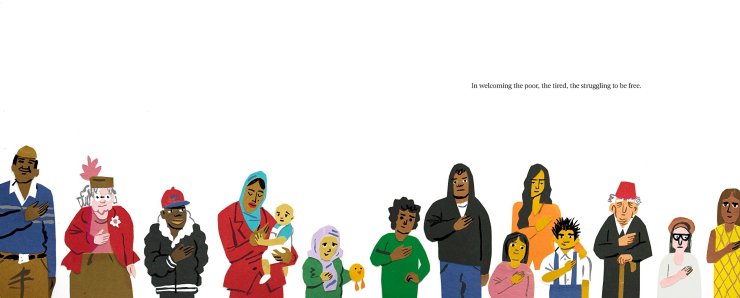
Illustrator Shawn Harris uses ink-and-construction-paper collages in the book. His pictures represents the value of equal acceptance of race, gender, religion, class, poverty, environment, education through immigration to the United States. One example of this acceptance through a critical perspective is in the below photo. This photo emerges as a diverse photo. It represents everyone, no matter who they are, pledging to the United States. It reflect’s socio-cultural changes and developments to our country. The author and illustrator represents cultural details and markers authentically and multidimensionally. These details are integrated through the illustrations in the text. All cultures and backgrounds are represented. Its not marginalized to one particular group.
Author Dave Egger’s is a United State’s citizen. He has written many books around the basis of human rights. Egger’s has many profound nonprofit works in the San Francisco area. Although he was not an immigrant that found home in the United States, Egger’s perspective is from a welcoming, American’s. He believes that the United States is shelter for immigrants and citizens alike.
In the beginning of the book, Dave Egger’s talks about France. The Statue of Liberty was created by Edouard de Laboulaye and Frederic Auguste Bartholdi. Laboulaye and Bartholdi were two french men. Dave Eggers and artist Shawn Harris depict France with the typical “french stereotypes.” These include, poodle’s, cafe’s, chefs, painters, and french kissing. This stereotype occurs when the author introduces France “If you have heard of France, you may have heard of the French. They are the people who live in France.
‘Wishtree’
Different languages, different food, different customs. That’s our neighborhood: wild and tangled and colorful. Like the best kind of garden.”
-Wishtree, Katherine Applegate
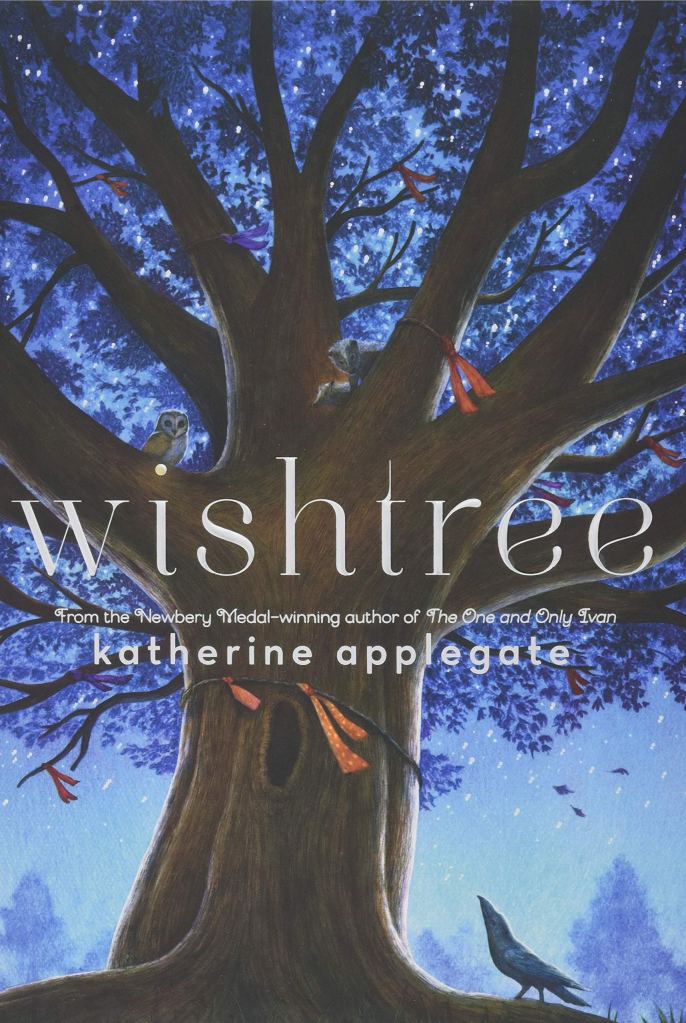
Red, is a 216-year-old oak tree. For many years, people have been coming to them on the first day of May to pin wishes on. Red gets covered with rags, notes, socks, and underwear. Some wishes left on the tree are nonsense while others are more serious and profound.
The first wish placed on the tree, many generations ago, was the wish of a young woman named Maeve. Maeve was an immigrant from Ireland who helped community members when they were sick. Maeve made everyone around her happy, however, she couldn’t make herself happy. Maeve wished for someone that she could love with all of her heart. The next day, Maeve’s wish was granted. She was left a infant at the bottom of the tree. That infant became the love of Maeve’s life.
Many generations later, Maeve’s great-granddaughter, Francesca, owns the house with Red on the property. She also owns the two houses across from the Oak tree, one red and one blue. The neighborhood had always been a welcoming place for families to live. However, when a young girl named Samar and her family moves in, things start to change. Someone carves the word “Leave” into Red’s trunk.
Samar’s neighbor, Stephen, is her age. Samar spends her day by the tree, wishing for a friend to accompany her. The animals of Red’s tree keep her company. However, her heart was longing for a human friend. Red becomes determined to grant that wish for Samar. With the help of the local animal friends, Red sets out to make Samar’s wish true. Stephen and Samar become friends over the unlikely bond of a talking tree. Red has the ultimate power in making choices for a better world. They want to continue to make the neighborhood a welcoming place. Red knows that once they bind Samar and Stephen, Samar and her family will be more accepted and feel more welcomed. It is up to Red to make this happen.
Throughout the course of the book, negative attention is brought to Red. Francesca want’s to tear down Red because of the hateful words that have been written on their trunk. Red has been a symbolic figure for many years, drawing many people to write wishes. However, it is up to Francesca’s jurisdiction to decide if Red lives. Through Samar and Stephen’s new found friendship, they come together to save Red’s life when Francesca tries tearing it down.
This story in not only about prejudice, but about life, death, friendship, love, and nature. Throughout the book, Samar and her family are marginalized in the text. When someone writes “Leave” on Red’s tree, it is made known that Samar and her family are Muslims. The lived experiences of muslims in America are represented just in this quote. Many Muslims in America are discriminated against. This text does an accurate job in touching on immigration of a new race.
“Other things happened. Someone threw raw eggs at the blue house. One afternoon, a car passed by, filled with angry men yelling angry things, things like “Muslims get out!”
-Wishtree, Katherine Applegate, Page 55
Katherine Applegate is a Newberry Medal winner. She lives in Northern California with her family. Katherine does not identify to be an #OwnVoices insider. She has accurately represented how many people view Muslims in our country. She has also represented how communities should come together to welcome people that are different than them. All are welcome here.
Text Set: Immigration into Friendship
‘My Two Blankets’, ‘Her Right Foot’, and ‘Wishtree’
All three of these books would make an excellent text set to discuss immigration. These books would particularly work in an Elementary school classroom. The idea of immigration from these books will allow younger children to grow a deeper mindset as to how immigration could affect our daily lives. These books also allow students to grow to love, accept, and create a welcoming community for those who are immigrants.
Connecting Immigration Back to the Books…
- My Two Blankets is about a young girl that moves to a new country. It has emphasis on how it feels to be different in an unfamiliar place and the importance of a friend. Friends allow you to feel more comfortable with who you are and welcome in a new place.
- Her Right Foot is a fun addition to the text set. This book is a nonfiction book about a popular landmark in the United States. Often, people see the Statue of Liberty and think of freedom. However, due to her right foot showing movement and action, we remember that the Statue, herself, was an immigrant. We need to remember when immigration started, and take action to welcome all of the immigrants into our country.
- Wishtree is about a beloved tree named Red that helps a world of hate overcome obstacles to show loving kindness. A Muslim family moves into Red’s neighborhood. It doesn’t take long for the neighboring community to make them feel unwelcome. Ugly messages are left on the tree, eggs are thrown at the house, and Samar, the young Muslim daughter, is pestered. Red takes it upon themselves to create a welcoming community and foster friendship.


